Part 2: Mass of a Solid
In many situations, we are given the mass-density of a
solid, which is a function m( x,y,z) measured in units of
mass per unit volume. Typically, if dM is the approximate mass of a small
``chunk'' of a solid with volume dV and if ( x,y,z) is a
point in that ``chunk'', then
which is to say that m( x,y,z) dV is the mass of a small
sample of a given solid.

In the same manner illustrated in section 3, the Riemann definition of the
triple integral then implies that the total mass of the solid S with mass
density m( x,y,z) is given by
|
M = |
 |
dM = |
|
m( x,y,z) dV |
|
That is, the mass of a solid depends on how dense it is.
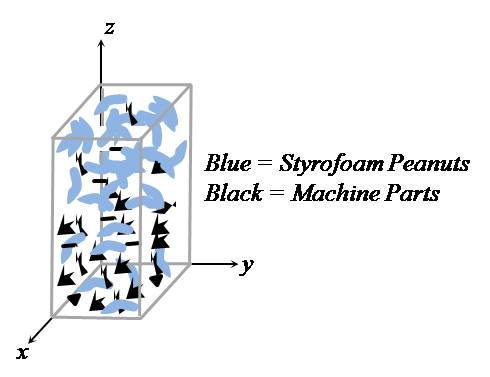
EXAMPLE 3 A box corresponding to [ 0,1] ×[ 0,1] ×[ 0,2] in xyz-coordinates is filled
with a mixture of small machine parts (heavy) and styrofoam peanuts (light),
which via settling is heavier at the bottom than the top.
If the mixture has a density of
|
m( x,y,z) = ( 9-z3) |
kg
m3
|
|
|
then what is the mass of the machine parts, styrofoam peanuts combination.
Solution: The mixture occupies the solid W corresponding to
the interior of the box. Thus, the mass of the mixture is
|
M = |
|
dM = |
|
m( x,y,z) dV |
|
This integral can then be reduced to a triple iterated integral
|
M = |
ó
õ
|
1
0
|
|
ó
õ
|
1
0
|
|
ó
õ
|
2
0
|
( 9-z3) dz dydx = |
ó
õ
|
1
0
|
|
ó
õ
|
1
0
|
9z- |
z4
4
|
ê
ê
|
2
0
|
dydx |
|
which reduces to M = 14 kg, which is about 31 lbs at sea level.
The settling means that near the bottom of the box (where z » 0 ), the mass density is about 9 kg per m3, whereas near the
top ( z » 2) the density is about m(x,y,2) = 9-8 = 1 kg per m3. Physically, this will means that the
center of mass should be lower than the point (0.5,0.5,1) we would have
expected for a uniform mixture, as we will explore in part 4.
The key is that the density m( x, y, z) is a tool for relating the physical quantity of
mass to the mathematical quantity of volume.
Alternatively, densities allow us to imagine that a geometric structure has a
physical manifestation.
EXAMPLE 4 What is the
mass of a tetrahedron with vertices at ( 0,0,0) , ( 1,0,0,) , ( 0,1,0) , and (
0,0,1) if it has a uniform mass density of m(x,y,z)
= 18 kg per cubic meter.
Solution: We begin by identifying the two surfaces that bound the
tetrahedron above and below. Since the upper face is flat, it corresponds to the
plane through ( 1,0,0) , ( 0,1,0), and ( 0,0,1) . Since u = á0-1,1-0,0-0
ñ = á -1,1,0
ñ and v = á 0-1,0-0,1-0
ñ = á -1,0,1
ñ are parallel to the plane, their cross product n = u×v
= á 1,1,1 ñ is normal to
the plane, thus implying that the equation of the plane is z = 1-x-y.
Thus, the tetrahedron is between z = 1-x-y
and z = 0 over the region R between x = 0, x = 1, y
= 0, and y = 1-x.
As a result, the mass of the tetrahedron T is
| M = |
ó
õ |
|
ó
õ |
|
ó
õ |
T
|
m( x,y,z)
dA = |
ó
õ |
|
ó
õ |
R
|
|
ó
õ |
1-x-y
0
|
18 dzdA |
|
Evaluating the first integral yields
| M = |
ó
õ |
|
ó
õ |
R
|
18( 1-x-y)
dA = |
ó
õ |
1
0
|
|
ó
õ |
1-x
0
|
18(1-x-y)
dydx = 3 |
|
Thus, the tetrahedron has a mass of 3 kg.
Check Your Reading: Geometrically, what are the faces of the tetrahedron?