Curves on a Surface
In general, a curve on a coordinate patch parameterized by
|
r( u,v) =
á x(u,v), y(u,v), z( u,v)
ñ |
|
is of the form r(t) = r( u(t), v(t) ), or equivalently, r(u,v) maps a curve ( u( t) ,v( t) ) in the uv-plane to a curve
r( t) on a surface.
The calculus of such curves r( t) is the same as
that in chapter 1 - that is, velocity, arclength, acceleration, etcetera,
are calculated in the same fashion as before.
EXAMPLE 1 The latitude-longitude parameterization of a sphere
of radius 2Ö2 is given by
|
r( j,q) = 2Ö2
á cos(j) cos( q) ,cos( j) sin( q) ,sin( j)
ñ |
|
What is the length of the curve r( t) = r( p/4, t) , t in [ 0,p/2] , which is an arc
at a constant 45° latitude between the points P(2,0,2) and Q( 0,2,2) ?
Solution: Since j = p/4 and q = t, the curve r(t) is given by
|
|
|
|
2Ö2 |  |
cos |
æ
è
|
|
p
4
|
ö
ø
|
cos( t), cos |
æ
è
|
|
p
4
|
ö
ø
|
sin(t), sin |
æ
è
|
|
p
4
|
ö
ø
|
|
 |
| |
|
|
2Ö2 |
|
|
1
Ö2
|
cos( t) , |
1
Ö2
|
sin( t) , |
1
Ö2
|
|
|
| |
|
|
á 2cos( t) ,2sin( t) ,2
ñ |
|
|
Thus, r' =
á -2sin( t) ,2cos( t) ,0
ñ and
|
|
ds
dt
|
= ||r' || = |

|
4sin2(t) +4cos2( t)
|
= Ö4 = 2 |
|
Consequently, the arclength is
|
L = |
ó
õ
|
p/2
0
|
|
ds
dt
|
dt = |
ó
õ
|
p/2
0
|
2dt = 2 |
æ
è
|
|
p
2
|
ö
ø
|
= p
|
|
However, it is often desirable to use the chain rule to find the
velocity r¢ of a curve r(t) = r( u( t) ,v( t) ) ,
since
|
r' (t) = ru |
du
dt
|
+ rv |
dv
dt
|
|
|
Equivalently,a curve v = f( u) is mapped to the curve r( u) = r( u,f( u) ) in a
coordinate patch r( u,v) and has a velocity of
|
r' ( u) = ru |
du
du
|
+ rv |
dv
du
|
= ru+rv |
dv
du
|
|
|
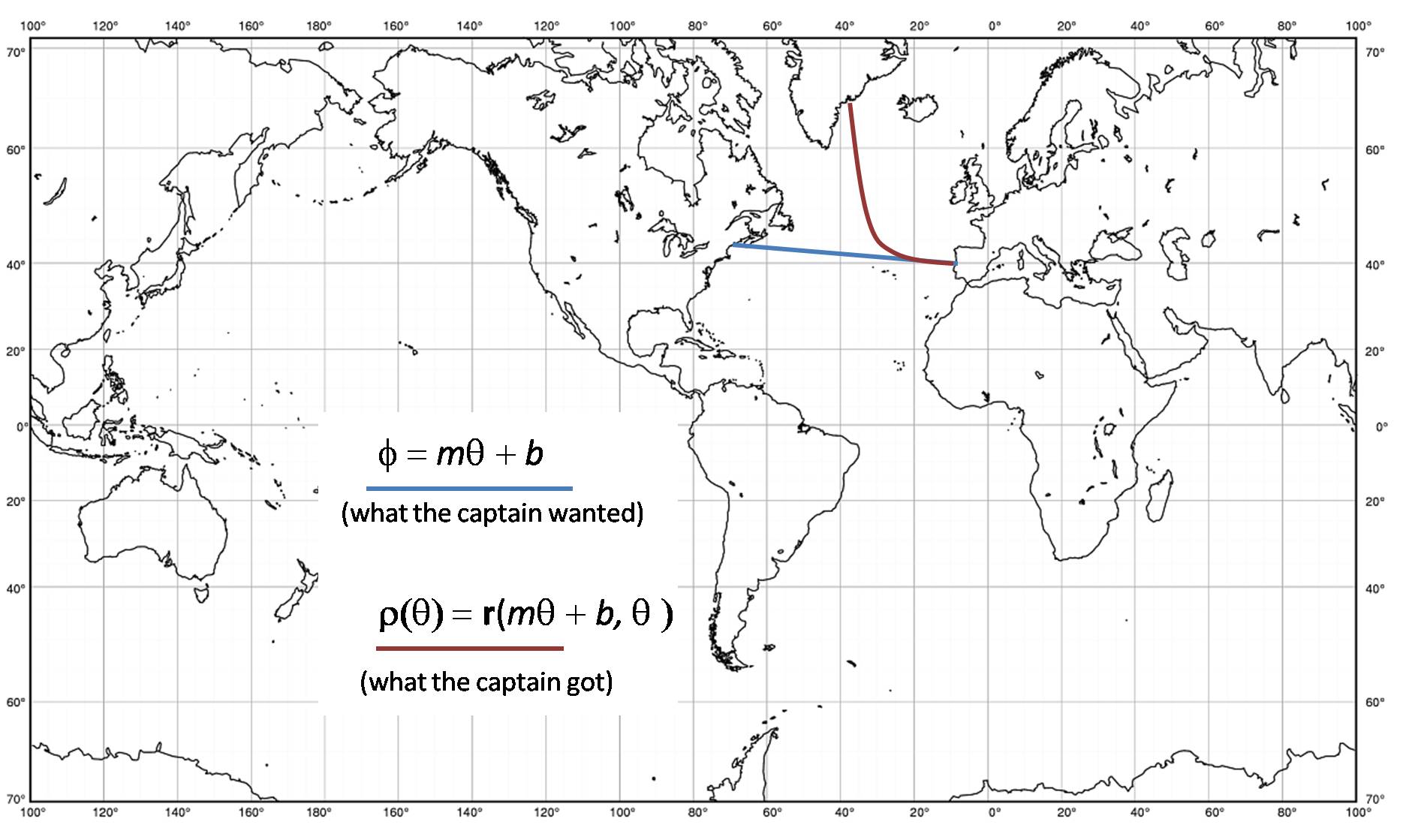
For example, a line j = mq+b in the qj-plane is
mapped to a curve r( q) = r(mq+b,q) on a sphere of radius R by the
latitude-longitude map
|
r( j,q) = R
á cos( j) cos( q), cos( j) sin(q), sin( j)
ñ |
|
(i.e., m and b are constant). The velocity of
r(q) is given by
|
r' = rj |
dj
dq
|
+ rq = mrj + rq |
|
which can be used to point out a deficiency in the latitude-longitude map. Namely, if m = tan( a) , then the line j = mq+b forms an angle a with each horizontal line in the jq-plane (i.e., the "paper map" the ship's captain uses to plot a
course). However, the corresponding angle on the globe, which is the angle
between r¢ and the horizontal vector rq, is not constant (and not equal to a).
EXAMPLE 2 What is the cosine of the angle b between r¢
and rq on the latitude-longitude parameterization of the
sphere of radius R?
Solution: Since the latitude-longitude parameterization is
orthogonal, it follows that
|
r' · rq = m rj·rq + rq·rq = ||rq||2 |
|
Since r' · rq = ||r' || ||rq|| cos( b), it follows that
|
cos( b) = |
r' · rq
|| r' || || rq||
|
= |
||rq||2
|| r' || ||rq||
|
= |
|| rq ||
|| r' ||
|
|
|
Moreover, orthogonality of the parameterization implies that
|
|| r' ||2 = m2||rj||2 + ||rq||2 |
|
Since rj is a unit vector and
|
rq =
á -cos( j) sin(q) ,cos( j) cos( q),0
ñ = cos( j)
á -sin(q) ,cos( q) ,0
ñ |
|
implies that ||rq|| = | cos( j) | , we are led to the following:
|
cos( b) = |
| cos( j)|
|
| |
m2+cos2( j)
|
|
|
| (1) |
The significance of (1) is that the angle b depends on both the slope m and the latitude j (except for m = 0 ). Indeed, as j approaches p/2, the angle b
also approaches p/2, which implies that the actual path on the earth
increasingly deviates from that on the "paper map" as the path increases in
latitude, and this deviation is toward the north pole (in the northern
hemisphere).
In contrast, as we will explore in the exercises, the Mercator
projection is conformal, which means that r( j,q) is an orthogonal parameterization with the property
Conformal means "shape-preserving," which in particular means that a path
on a "paper map" using the Mercator Projection is "the same" as the image of
the path under r( j,q) .
Check your Reading: Explain why if ru^rv and if v = aru + brv, then
|
v2 = a2 ||ru||2 + b2 ||rv||2 |
|