The Second Derivative Test
Clearly, f( x,y) has a local maximum at a critical
point ( p,q) only if every vertical slice of z = f(x,y) has a maximum at ( p,q) .

Similarly, f( x,y) has a local minimum at a critical point ( p,q) only if every vertical slice of z = f( x,y)
has a minimum at ( p,q) .
However, it is possible for f( x,y) to have a minimum in one
slice and a maximum in another slice.
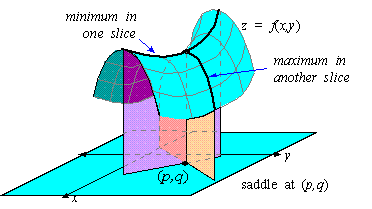
If this is the case, then we say that f( x,y) has a saddle at ( p,q) , because the resulting surface resembles a
saddle for a horse.
To determine if we get a maximum, a minimum, or a saddle point at a critical
point ( p,q), we consider the vertical slice z(t) = f(p+mt, q+nt).
Since x = p+mt and y = q+nt implies that
x' (t) = m and y'
(t) = n, the first derivative of z(t) is
|
|
dz
dt
|
= |
¶f
¶x
|
|
dx
dt
|
+ |
¶f
¶y
|
|
dy
dt
|
= mfx+nfy |
|
Moreover, m and n constant implies that
|
|
|
| |
|
|
m |
æ
è
|
|
¶fx
¶x
|
|
dx
dt
|
+ |
¶fx
¶y
|
|
dy
dt
|
ö
ø
|
+n |
æ
è
|
|
¶fy
¶x
|
|
dx
dt
|
+ |
¶fy
¶y
|
|
dy
dt
|
ö
ø
|
|
| |
|
| m( mfxx+nfxy ) +n( mfyx+nfyy ) |
|
|
Expanding and using the equality of the mixed partial derivatives then
yields
|
z"(0) = m2fxx( p,q) + 2mnfxy( p,q) + n2fyy( p,q) |
| (2) |
If fxx(p,q) = 0, then we can choose values of m and n
such
that z'' is negative in some slices and positive in
others, thus implying that z=f(x,y) has a saddle at (p,q). If fxx(p,q) ¹ 0, then completing the square in m yields
|
z"(0) = fxx( p,q) |
æ
è
|
m + |
fxy( p,q)
fxx( p,q)
|
n |
ö
ø
|
2
|
+ |
D( p,q)
fxx( p,q)
|
n2 |
| (3) |
where D = fxxfyy - ( fxy) 2 is called the discriminant of f. (i.e., expanding (3) will result in (2) ).
If D( p,q)
> 0, then
z"(0) has the same
sign as fxx( p,q) in all directions u =
<m,n>, thus implying a maximum if fxx( p,q)
< 0 and a minimum if fxx( p,q)
> 0. However, if D( p,q)
< 0, then choosing m=1, n=0 yields
z"(0) > 0, whereas choosing m =
fxx( p,q) / fxx( p,q)
n yields
z"(0) < 0, thus implying a saddle. These observations lead to the following theorem:
Second Derivative Test: If ( p,q) is a critical point
of a function f( x,y) whose second derivatives exist at ( p,q) , then
|
|
| | | |
| | | |
f( x,y) has a local minimum at ( p,q) |
|
| | | |
f( x,y) has a local maximum at ( p,q) |
|
| | | |
f( x,y) has a saddle at ( p,q) |
|
|
|
|
However, if D( p,q) = 0, then no information about f( x,y)
is obtained.
EXAMPLE 2 Identify the extrema and saddle points of f(x,y) = x2-y2.
Solution: Since fx = 2x and fy = -2y, the only critical point
is ( 0,0) . However, fxx = 2, fyy = -2, and fxy = 0,
so that the discriminant of f is
|
D = fxxfyy-( fxy) 2 = ( 2) ( -2)-02 = -4 < 0 |
|
Thus, f( x,y) = x2-y2 has a saddle at ( 0,0) .
EXAMPLE 3 Find the extrema and saddle points of f(x,y) = x3-3xy+y3.
Solution: In example 1, we showed that the critical points of f
are ( 0,0) and ( 1,1) . Since fx(x,y) = 3x2-3y and fy( x,y) = -3x+3y2, the second
derivatives of f( x,y) are
|
fxx = 6x, fxy = -3, fyy = 6y |
|
Thus, the discriminant is
|
D( x,y) = ( 6x) ( 6y) - ( -3)2 = 36xy-9 |
|
At ( 0,0) , we have D( 0,0) = 0 - 9 = -9 < 0. Thus, f
has a saddle at ( 0,0) . At ( 1,1) , we
have
|
D( 1,1) = 36·1·1 - 9 = 27 > 0 |
|
However, fxx( 1,1) = 6 > 0, so f has a local minimum
at ( 1,1) .
EXAMPLE 4 Find the local extrema and saddle points of
Solution: The first partial derivatives are
|
fx = sin(xy) + xycos(xy), fy = x2cos( xy) |
|
Setting fy = 0 yields either x = 0 or cos( xy) = 0, the
latter of which implies that
for any integer n. At such points, we would have fx(x,y) either as 1 or -1 (but not 0). However, if y = 0, then
which implies that both fx = 0 and fy = 0 at (0, 0) (and
nowhere else). The second derivatives are
|
|
|
| |
|
|
fyx = 2xcos(xy) - x2ysin(xy) |
| |
|
|
|
and fxx( 0,0) = fxy( 0,0) = fyy(0,0) = 0. Thus, the discriminant is D( 0,0) = 0, so the
second derivative test provides no information about the extrema or saddles
of f( x,y) = xsin( xy) at (0,0) .
Although it appears that there is a saddle at (0,0) in example 4, there is no
way of determining this using the second derivative test. Indeed, g(x,y) =
x4 + y4 is positive everywhere except for g(0,0)
= 0, so clearly g(x,y) has a minimum at (0,0). But gxx( 0,0) = gxy( 0,0) = gyy(0,0)
= 0 implies that D(0,0) = 0, so this minimum cannot be identified using
the second derivative test.
Check your reading: Does p( x,y) = -x4 -y4
have any local extrema that can be identified using the second derivative test?
